Naked and spectacular

Total pageviews

Showing posts with label film. Show all posts

2023-03-04

Punch (2022) Welby Ings, New Zealand -98m-

A young boxer in small town New Zealand trains hard under pressure from his alcoholic father and meets an unassimilated gay man living in a shack on the beach.


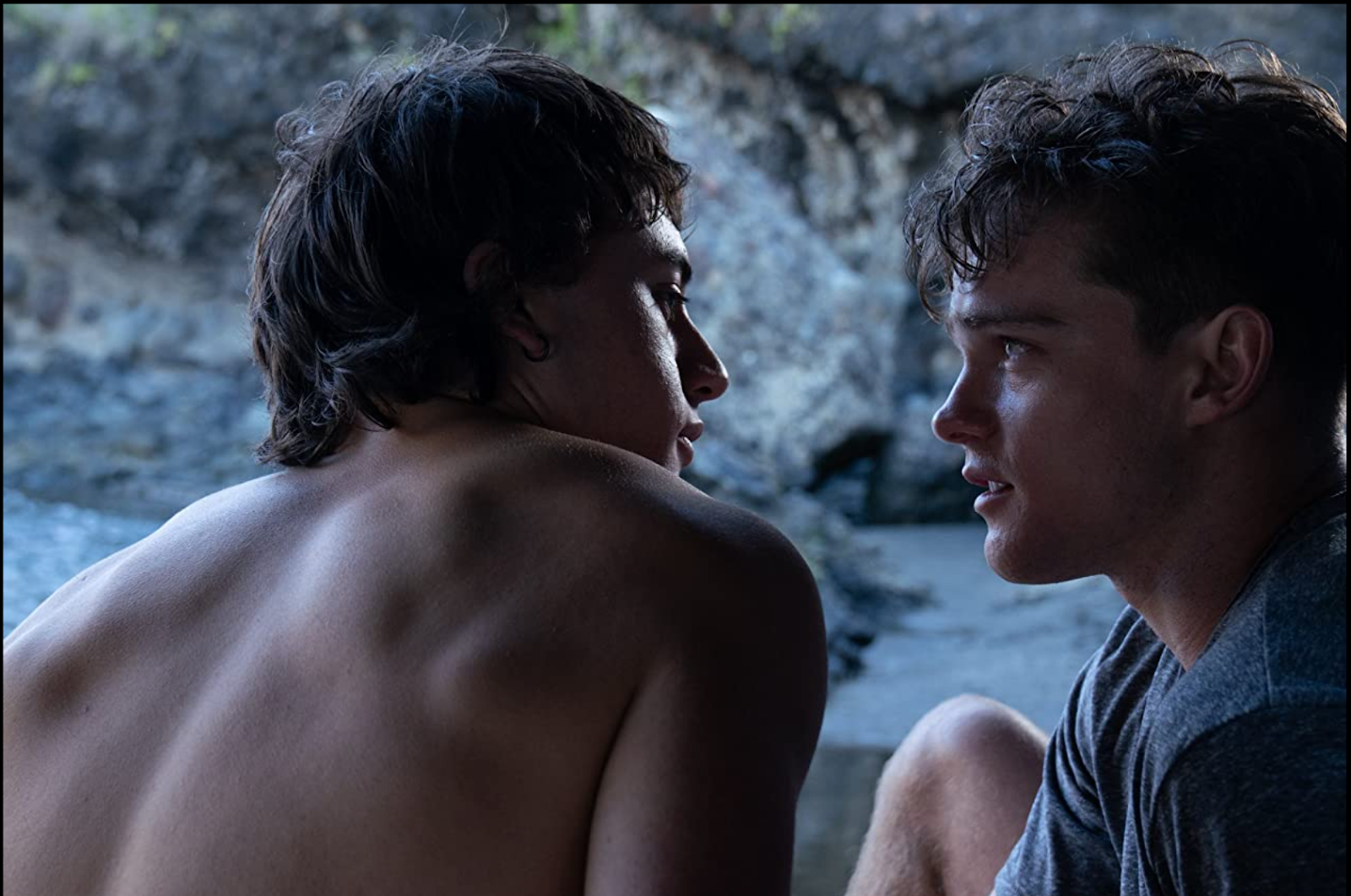
Tim Roth has top billing as an exhausted alcoholic with no energy left for anything in life apart from his son's boxing training, but his character definitely takes a backseat to the two distinctive and empathetic young men, played by Jordan Oosterhof and Conan Hayes. Oosterhof plays Jim, a boxer with a lean, muscular body and sensitive blue eyes, who passes in this shitty, uptight small town because he's an athlete and masculine. Hayes plays Whetu, who is a social reject from the start of the film; gay, out and Māori, with no known social connections. He is an artist and a sex worker and has carved a tiny world for himself in a beautifully decorated shack in the sand dunes of a big empty black-sand beach past a “no trespassing” sign.


The two characters are so vividly drawn and delicately performed that their coming together is real and meaningful, because we know why they reach for each other in such a place. Away from the highly constrictive social expectations of the town they have a little paradise in Whetu's shack, decorated with many odd artefacts found and created by him. It is through each of them seeking solitude in the wilderness of the beach that they meet, and it is here that they are able to spend time, nurture each other and find love.


The small town of Pīrau and the other characters that inhabit it are merely mise-en-scene for their relationship and the transformation it allows in each of them. It successfully colours in the background that contextualises their internal and external limitations and their expanding identities. A small town with no opportunities, a culture and people who are determined to aggressively limit each other. They are two young men who have allowed themselves to enjoy rich inner worlds, who have not been deadened by small town life and of course will inevitably escape.


Their first encounter is when Jim, passing with his straight mates, drive past Whetu and call out “faggot”. Whetu is already known as an outsider, but at that moment Jim is curious enough to turn around for another look. Their first meeting is on the beach. Jim often goes out there to train and this time, believing he is alone, he gets naked and runs through the dunes and the surf. Whetu is hanging out with his little dog and Jim is embarrassed and instinctively defensive. They tell each other to fuck off and Whetu shouts, “This is Māori land!” This remote empty beach is clearly a sanctuary of safety and self-expression for each of them, and they have invaded each other's space. Their next meeting, Whetu is weaving flax in the dunes when Jim gets stung by a jellyfish and screams for help. Whetu takes him to his little shack hidden in the dunes on a stream bed, pulls out the tentacles and rinses his stings with vinegar. Jim is very impressed with the tranquillity of the place and the care put into each of the strange objects that decorate it. To Whetu's surprise, Jim returns the next day and they discover a place of mutual sanctuary where they can connect away from the expectations and derision of the town.


This is the first feature film from Welby Ings, who has made various shorts. The two characters here are clearly enriched by the protagonists in his short films Sparrow (2016) and Boy (2004). Sparrow is about a sensitive and isolated boy, who wants to fly and never takes off his home-made wings, coming to terms with the macho images he's expected to live up to. Jim tells Whetu about how when he was a child he used to come to the dunes with his wings and try to fly. We briefly observe a spiritual trace of them discarded in the sand as Jim rediscovers his open-heartedness with Whetu. The protagonist of Boy is an isolated teenager who is scorned by the town, a sex worker who picks up men in the public toilet and who has a sanctuary in an abandoned warehouse where he creates strange and beautiful doll sculptures. Whetu is a sex worker who makes no effort to fit into the roles this small-minded town finds acceptable and who instead creates a solo world for himself with strange, beautiful sculptures. Having seen these shorts, both of which can be streamed for free, the lives of these characters are real outside of the events and timeline of the present film. Though they encounter each other at this pertinent moment when they're both ready for change, they have pasts that can only be hinted at, inner worlds that they can only attempt to express to each other, and futures outside of Pīrau in which they will create something totally different of themselves. We get a joyous and moving glimpse of this future at the end.


These shorts were also poetic in the sense that they didn't really work on a narrative level and though they hinted at the beautiful inner worlds of these strange isolated boys they remained somewhat unsatisfying. In Punch he has created a more conventional narrative film with satisfying character arcs, but retained the delicate, poetic hinting at rich inner worlds; Whetu drinking wine from a china teacup; Jim running naked through the dunes. The narrative takes breaks into moments of subjectivity, some beautiful imagery and a little too much use of distorting lenses. The gentle pacing of the protagonists discovering each other was engaging, though the ending was unfortunately abrupt and unresolved.


It is typical to cast pretty actors to play romantic leads, but here we find characters who we love because they are beautiful as complete humans. The love story refreshingly has nothing to do with perpetuating the romantic myth or attaining the higher state of a monogamous committed relationship. These two characters, so coherently woven into the world of this moving film, are merely two people who take the opportunity to open their hearts to each other before moving on with their lives.


2020-09-02

Tenet [2020] by Christopher Nolan

Loud and impenetrable

A man on an international mission to save the world from the deadliest weapon of all, the future.

Two moods: excessive incomprehensible exposition and LOUD incomprehensible action sequences. At no point do you know what is going on, nor are you given any reason to care. It is at all times tedious, meaningless and irritating. None of the characters are remotely interesting, much of the dialogue is inaudible and the ridiculous convolutions add up to nothing. And this cost over $200 million to make.

2017-09-02

12 Years a Slave [2013] by Steve McQueen

Violence without insight
The film's brutal and noble depiction of American slavery being unjust seemingly makes the film impervious to criticism. I happen to agree that slavery is an abomination, but I don't think that is a question being discussed in America or the world at the moment. As far as I know, it is a question that has been answered already. But the Academy can't help but pat themselves on the back because they have, for the first time, given their Best Picture award to a film written and directed by black filmmakers. Instead of feeling proud, I may instead wonder why they haven't been giving awards to filmmakers of diversity all these years. I suppose they are an American institution and they focus on American films and films that engage with the American sensibility. In this case they have chosen to acknowledge an issue which has largely been sorted in the American cultural mind.
I suppose it is a long process rewriting history to include the stories of the marginalised. This is a process that needs to happen, and for many people this is a process that needs to happen in large-scale accessible films that will be seen by many. Thus the film has its place.
However, the film doesn't offer any depth into the situation. There is no insight achieved into how this could happen, what toxic ideologies justified this culture on a political or a personal level. There was no attempt to place this man's experience into any large context at all. It was merely a depiction of the nobility of waiting for justice. For 12 years he worked as a slave and barely dared confront the legal injustice of his situation, let alone the moral injustice of it. He nobly waited for 12 years and eventually justice was done and he was able to return home to his family.
Titles at the end of the film not only tell us that the kidnappers were not brought to justice, but that the protagonist's salvation was extremely anomalous. Most free black people sold into slavery illegally were never freed. But that is not an inspiring story of overcoming adversity. That is a more accurate rewriting of American history to include the stories of marginalised, but not one that reinforces American values of waiting for things to get better, waiting for justice to have an opportunity to be done.
The violence of this film did not offer us a rewarding and insightful commentary on the grotesque cultural and political landscape of America that allowed slavery to flourish for so long.

2017-08-24

Melbourne Cinémathèque: Paul Verhoeven's Starships Troopers [1997] and Robocop [1987]

I saw my first film on DCP in 2009, so it has only been ubiquitous a few years, but already 35mm feels evocative of an earlier analogue age. The imperfections on the print seem to smell like popcorn, though there was none in the cinema at ACMI for the Melbourne Cinémathèque screenings of Paul Verhoeven's films Starship Troopers and Robocop.

The films have similar intentions, depicting a militarised and propagandised society, with Starship Troopers being considerably more extreme and less subtle than its predecessor. 

Starship Troopers is set in a globally unified 2197 in which everyone has American accents and knows who the bad guys are: the bugs. Nationalistic propaganda is depicted with overstated irony and we seem to be in permanent war with the sub-human and sub-intelligent beasts, whose territory we may have arrogantly encroached upon. 

But no matter, because the battle against evil unifies us as a society and citizenship (as well as voting rights) is the exclusive privilege of those who have served in the military. Even as millions are slaughtered in futile battles, more are recruited in hope of serving the society that entirely encompasses and protects them. 

Despite all the political satire, the film is not to be taken too seriously. It wields Hollywood cliche, bad acting, elaborate special effects and video game-like violence to the purpose of pure movie fun and thrills, tensing up at the threat to our heroes as we laugh at how ridiculous it all is.  The film wants it both ways: to satirise American military chic and "freedom", as the ability to choose to die for your country (or planet), and to totally relish in the thrill of the Hollywood science fiction action war film, with its big budget, special effects, exciting music and editing and pretty actors, and it mostly succeeds.


Starship Troopers is a bit thin on the irony though, and Robocop is a more successful and satisfying film in every way.

Robocop is set in the nearer future, in which the Detroit Police department has been contracted to a private company with some pretty nefarious intentions.  Now that the Police have been privatised, the next step is to mechanise the cops themselves and so crime can be fought by programmed and emotionless machines without human error, but perhaps with the type of error that only machines, psychopathic corporations and fascism can offer.

Robocop can be interestingly compared to Christopher Nolan's The Dark Knight Rises (2012) with very interesting implications.  I have already written about how Nolan's film supports the fascist notion that the masses are dumb and helpless and must be saved from evil by psychopaths in uniforms and masks.  Nolan's Interstellar (2014) also presents the idea that the masses must be lied to in order to save them from what they're not capable of understanding.  And Nolan's films are presented without irony or humour.  We must trust in our great institutions and we must not question them because we are ignorant to the complex manner in which they will save us.  This seems to be the ideology of the 21st century Hollywood machine.  The '80s and '90s were different.  Rewatching the four Batman films released between 1989 and 1997 there is an astonishing lack of any ideological underpinnings in all except one of them, Batman Returns (1992).  This film chooses Catwoman and Penguin as the villians, but in both cases the real villian is not even the dim, charming and manipulable mayor, but Max Shreck (a vampire?), the corrupt corporate executive who is responsible for traumatising both Catwoman and Penguin into the dangerous freaks they become.  The film is ultimately feminist and anti-corporate and causes us to question the powerful institutions that do not necessarily have our best interests at heart.  Quite contrary to Nolan's suggestion that we have blind faith in them to save us from evil because we are inherently ignorant.

Verhoeven, in Robocop, plays with both of these elements, fascistic violence overcoming crime, and the vapid money-obsessed corruption of our corporate class, with considerable wit and fun.  The technocratic violence is effective against crime, but only when it is combined with a human element, as in the half-human/half-robot, but it is ultimately doomed to failure because of the compromises of the perverted intentions of the executives running the institution.  And although the masses are not necessarily depicted as stupid in Verhoeven's film, they are saturated with an incessant and compellingly stupid media pumping them full of inanity as coke-driven criminals and coke-driven executives unleash violent crime on their vulnerable city.

It all sounds rather serious and intense the way I am describing it, but it is actually constantly fun and funny, thrilling and stupid, offering you the dumb thrills you learned to love as a child and the clever irony you need as a thinking adult.

Both of Verhoeven's films draw you into the dumb violence of Hollywood and its fascist ideology of redemptive violence led by all-powerful institutions, but they also ridicule its grotesque consequences and the ludicrous propaganda supposed to convince us of its efficacy.

But if you're in the right mood, they're just fun too.