Naked and spectacular

Total pageviews

2021-12-03

Early cinema of Jane Campion (1990) by Bill Gosden

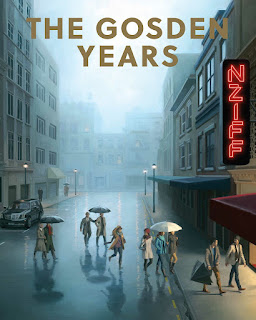
Bill Gosden was, for almost 40 years, director of the New Zealand International Film Festival.  Upon the one-year anniversary of his death The Gosden Years was released by Victoria University Press.  It is a beautifully produced collection of his writing about cinema and the art of the film festival.  His huge contribution to Aotearoa cinema culture as an exhibitor and curator is widely appreciated.  This book acknowledges his contribution to writing about film and the innovative poster art that he often collaborated with designers and artists to create.  Below is an article not included in the book that he wrote in 1990.
Early cinema of Jane Campion (1990)

A tragic tale of suffocation by family, shot through with bizarre, black comedy, Sweetie is a daring, original and, I think, marvellous movie. It parodies neurotic behaviour while exhibiting an intense commitment to the neurotic point of view. It's a potent blend. Comedy heightens tragedy, tragedy heightens comedy until you can't tell one from the other.

In competition at Cannes, Sweetie's emptied-out performances and full-on visual style earned the contempt of French experts who recognised contrivance but lacked any understanding of the verbally inarticulate world Campion was contriving to express. Closer to home there have been plenty, equally uncomprehending, who found Sweetie equally infuriating. “The work of an enthusiastic amateur,” sniffed one New Zealand critic.

Sweetie, it seems, is a film you love or hate. There have been as many accolades as insults; the film has even won prizes in France. Because her work has such a distinctively Australian/New Zealand inflection (or twang, if you prefer), it's a relief to us hometown cheerleaders that Sweetie has accumulated admirers throughout the English-speaking world.

For if Jane Campion is an amateur then she is so only in the sense that not one of her films contains a hint of professional assignment. In ten years she has expressed a rich, strikingly individual view of the world in a remarkably varied, utterly coherent body of work.

Sex with Straight Guys

 Originally published in RFD #186, "Summer of Sleaze II", the international Radical Faerie magazine.


Recently I was sitting in a cafe overhearing a conversation between two straight guys. “I wanna get fucked tonight. I haven't been fucked in ages.” “Fuck yeah, dude, I really need to get fucked too.” They were talking about getting drunk, but it's not what it sounded like to me. What is it about straight guys? Is it simply wanting what I can't have? An addiction to disappointment and rejection? That particular nonchalance? Sometimes it feels extra special when someone chooses to engage with me because they are truly interested in me, rather than cos we like the same stuff sexually. Sometimes I think “straight guy” is a mental illness. The ones I love are gentle, loving, with intelligence and integrity. Why, then, are they so uptight? In my desire to fully explore the depths of connection with a special guy, I don't care if he's straight, but usually he does. For this reason we have found a strange, wonderful and dodgy array of ways in which to manifest our mutual desire to connect when our visions of connection are so different.


Darby first captured my erotic attention one stoned night in our student flat. He cornered me in the kitchen, picked up a knife and offered to cut me open and eat my intestines. Semi-erect and scared of death, I was frozen and silent, stupefied. Another night, when I was drunk and vomiting, hanging over his toilet, he thoughtfully and lovingly got me naked and into the shower to bring me back to life. Afterwards we stood together and he leaned in to kiss me. I leaned in and he leaned back, he leaned forward again and leaned back when I came close, a deliberate cruel tease. I joyously allowed myself to be manipulated while simultaneously developing a genuine friendship with this fascinating and narcissistic guy. Trying to start an orgy, he called me into the bathroom where he was hard and inside his girlfriend, inviting me to play with his balls. We became best friends and went out to a gay club together, just the two of us. “I'm definitely bi,” he shouted in my ear over the noise. “Some of these guys are hot!” Back at his place I don't know how he was feeling but I was horny as fuck, resulting in a very intense wrestling match in our underwear, throwing each other around the room, slamming against the walls. We never expressed physical intimacy together in private, though I did suck his cock briefly in another awkward group sex situation and I still remember the look of pleasure and disgust on his face. Eventually I got so in my head about the relationship that we couldn't even be friends anymore.


2021-03-09

Cousins [2021] by Briar Grace-Smith and Ainsley Gardiner

 Entwines the very different lives of three Maori girls, cousins, through tumultuous decades, after one of them is taken from her family and raised in an orphanage.


A very moving and cinematic adaptation of Patricia Grace's novel, very effectively condensed into movie length while maintaining the scope and complexity of the multiple threads. The lives of these three women, though particular and intimate, effectively represents a larger story of a culture interrupted by colonialism but regaining its strength and groundedness. The interaction between the personal and the cultural, memory and the moment, are woven together with various events, spanning decades, creating a complex portrait revealing how the past, the present and the future interact with each other, how members of a family interact through space and time, in life and in death.  Though the performances were sometimes uneven, the editing and Terence Malick-like cinematography very skillfully conveyed a specific yet expansive spiritual and cultural journey through the entire lives of three compelling and tangible characters.

2021-03-07

Raiders of the Lost Ark [1981] by Steven Spielberg

 American arrogance as entertainment product

Why is Indiana Jones the hero of this movie? He murders hundreds of people in order to steal valuable artefacts from poor countries. He's not even charming. He's just American. His intelligence is entirely unconvincing. His only apparent ability is determination, and of course miraculous amounts of luck. He is the hero cos John Williams's score makes a catchy noise when he takes action. Ford's performance is only grimace, brawn and hat.

2020-09-02

Tenet [2020] by Christopher Nolan

Loud and impenetrable

A man on an international mission to save the world from the deadliest weapon of all, the future.

Two moods: excessive incomprehensible exposition and LOUD incomprehensible action sequences. At no point do you know what is going on, nor are you given any reason to care. It is at all times tedious, meaningless and irritating. None of the characters are remotely interesting, much of the dialogue is inaudible and the ridiculous convolutions add up to nothing. And this cost over $200 million to make.

2018-11-22

Death in Venice [1971] by Luchino Visconti


Death in Venice is a sumptuously beautiful Technicolor immersion into pesilential Venice. Dirk Bogarde gives a lot in his performance as the isolated composer Gustav von Aschenbach.  He is holidaying alone in Venice to recover from the overwhelming stresses of his life, particularly of being massively uptight and self-denying, while simultaneously giving of himself through the committed and considered perfection of his music. 

Flashbacks of passionate conversations with a friend spell out explicitly how we are to interpret the present scenes in Venice. There is no separation between the man and his music; he expects perfection of himself, moral purity, and no corruption through a mere pleasure of the senses. He dreams of a spiritual beauty that is pure and perfect. And he discovers this in the beautiful form of a teenage boy he sees in his Venice hotel, holidaying with his family, the magnificently beautiful Björn Andérsen. He observes this boy from afar but does not dare to approach him. Tadzio notices his attention and is as captivated by his gaze as Gustav is captivated to gaze upon him. But, as we are so clearly told in the flashback philosophical conversations, his engagement with life is as a detached observer.

Bogarde's performance is excruciating in its precision and commitment to communicating, through almost no dialogue and often merely sitting alone, the painful self-loathing expressed as pomposity and cowardice. Gustav is horrified in the beginning to encounter a painted and flamboyant queen who addresses him on equal terms, as if to a fellow queen. He does not want to humiliate himself with such shameless abandon.

Tadzio plays with his attention and the power it gives him, but Gustav cannot act, cannot place himself on the line, cannot risk to feel so much, cannot allow himself the potential pleasure promised by engagement with this beautiful young man fluttering about in front of him like a butterfly. I suppose this self-loathing and self-denial speaks to a very specific queer experience that would have been all too common at the time, and only somewhat less so today. The expression of queer desire and admiration of beauty is more permissible in Western societies today, but the admiration of the beauty of adolescent boys, is less permissible perhaps.

Gustav's struggle is as much present in the languorous gaze of the camera, its subtle movements and carefully editing, as it is in Bogarde's performance.

While I find it unpleasant to identify with Bogarde's character in very personal and humiliating ways the film remains a work of beauty and sympathy, with the squalid and dangerous beauty of Venice and the as-yet-uncorrupted beauty of Tadzio, perhaps equally dangerous.

2018-11-14

Never Say Die [1988] by Geoff Murphy

Flashbacks with Geoff Murphy - A Retrospective Trip

The Geoff Murphy retrospective at Ngā Taonga Sight & Vision (the film archive) in Wellington has begun and runs until 30 November.

It begins with Never Say Die (1988). A young couple are mysteriously pursued by people with increasingly elaborate attempts to kill them; they narrowly escape death repeatedly. A sexy, fun and totally incoherent thriller full of car chases and shoot-outs; with a plot that barely manages to justify the set pieces and certainly doesn't do anything else. A Lethal Weapon-style '80s Hitchcock leaning precariously towards a Buster Keaton routine. Ultimately trash, but light and effortless, with sexy and engaging star performances from Temuera Morrison and Lisa Eilbacher. If the film has any meaning perhaps it can be contained in the opening narration in which Tem's character complains about the narrow-minded Kiwi mentality, as long as you know that this film, so obviously a plea for attention from Hollywood, was Murphy's last film in New Zealand before his long journey in America as a director for hire.


2018-10-27

Uneasy Dream and Other Things by Lori Leigh

Image result for uneasy dreams and other things
What a joy when Wellington theatre can make me feel like I'm in Melbourne, a sexy vibrant city of novelty and risk; young people who are smart and funny and have something to say.  I have no time or patience anymore for tradition, formality or familiarity.  I want to be surprised, delighted and truly moved, as the perverse, irrational and ridiculous human being that I am; and not just in my head, but in my body and in my soul.  I want to laugh without feeling condescended.  I want to think without having to bend myself around lifeless abstractions.  I want characters who are flesh creatures in front of me, obscene, beautiful, tender, angry, outrageous, loose, intelligent and sexy.  I want fantasy that deepens my reality.  I want to see something that could never happen, and I want that to bring me more fully into the reality of my life.  I want to leave the theatre burning with life, wanting to dance on the street, to dive off the wharf, wanting to fuck a stranger, to fall in love, wanting to live more fully, to perform myself, wanting to realise myself as I've always wanted to realise myself.

And this is the second time this has happened after seeing a play in Circa's smaller, more adventurous, performance space as part of the Women's Theatre Festival.  This time it was Uneasy Dreams and Other Things by Lori Leigh, a play about a woman who wakes up one day with a penis.  Does that make her a man?  Does that make her husband gay?  Will people accept her as she is?

We meet four characters with frailties and arrogances and needs and desires and shames and confusions and senses of humour.  Sam (Lydia Peckham) is a woman who struggles at work, with all the fake macho bullshit of working for a marketing company.  Her boss tells her to "grow a pair", if she hardens up she'll do better.  Her husband, Greg (Matthew Staijen-Leach) doesn't enjoy work either, but he does it cos he wants them to get their mortgage and have their family.  Greg's brother Fran (Arlo Gibson) is living with them too, but he doesn't work.  He's in a cover band and prefers to get up at 15.00.  Sam's best friend Reta (Johanna Cosgrove) spends more time at her house when Sam stops going to work.  She needs her friend.  Work's shit without her friend around to make it tolerable.

All these people need each other, something beautiful about this play.  I want to watch characters who need each other.  I need people too, what could be more human?  They may not even know what they need from each other.  Or maybe they know perfectly well.  Maybe this leads to disappointment.  Or maybe they're just too scared to tell us what they want.  But a good playwright draws us gently and tenderly into that space in a character and I was very happy to see it on stage this evening.

2018-09-29

The Departed [2006] by Martin Scorsese


I don't understand how there can be near-unanimous acclaim for this film. Is it because Martin Scorsese and his renowned cast can do no wrong? Who can question the work of three-time Academy Award winning actor and legend Jack Nicholson? He is one of the best actors of his generation and of course when his fellow actors were promoting the film they all spoken about how much of a privilege it was to work with him. Is it difficult to notice that he can't actually act anymore; that he merely caricatures himself? Maybe he destroyed himself with playing The Joker in Batman (1989) for which he was given a percentage of the profits and made about $60 million dollars for one of the worst performances from a great actor in the history of cinema. His performance in The Departed was barely more restrained than The Joker. His performance is like a cartoon and utterly unconvincing as a real human being, despite being surrounded by grounded, effective performances. This makes sense discovering that he was given free-reign on set to improvise and ham it up, his director trusting that he is still a great artist, or simply too afraid to question him. Despite Scorsese's definite competence, Nicholson is unrestrained and detrimental.