Naked and spectacular

Total pageviews

Showing posts with label queer. Show all posts

2023-03-04

Punch (2022) Welby Ings, New Zealand -98m-

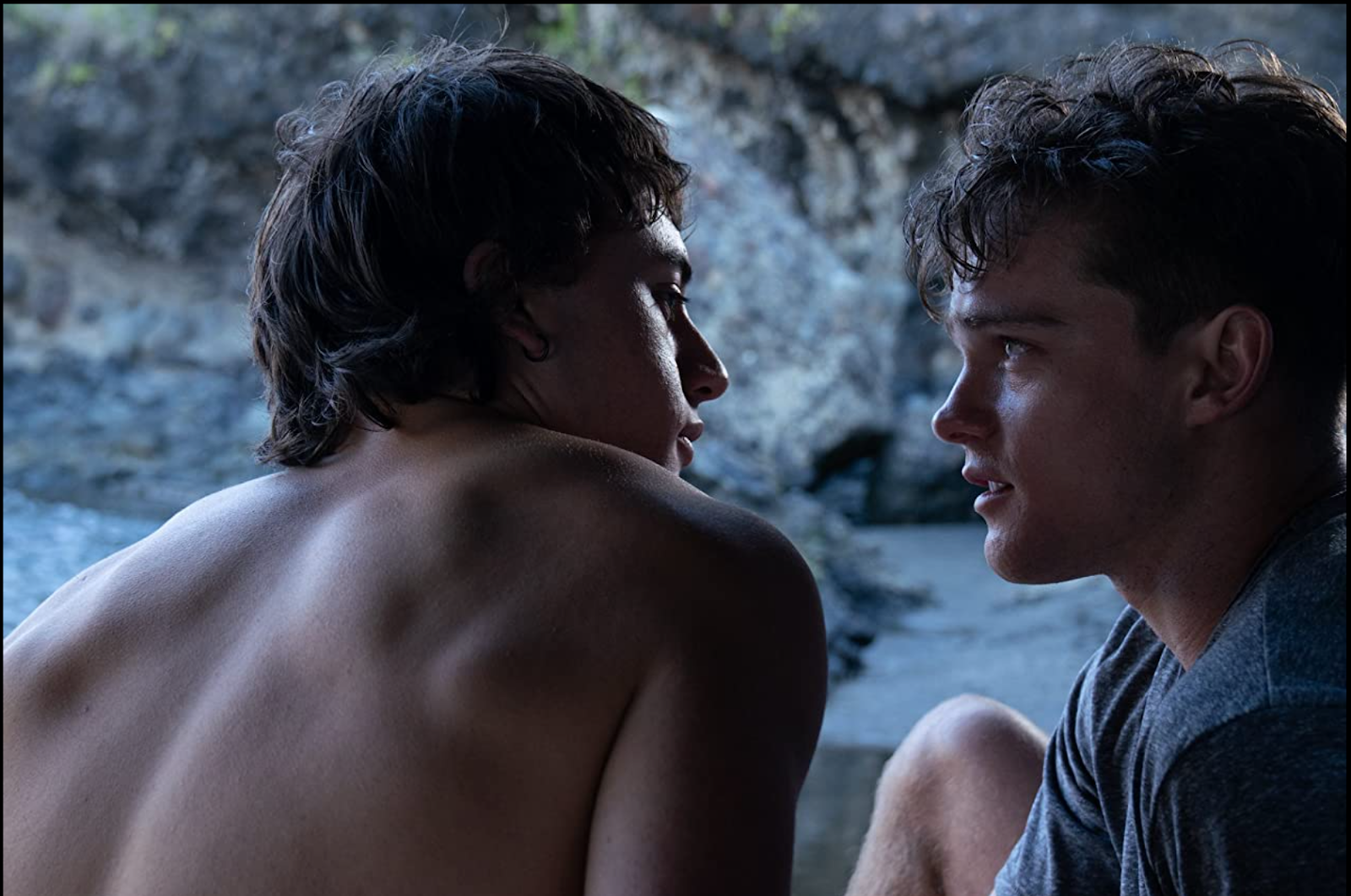
A young boxer in small town New Zealand trains hard under pressure from his alcoholic father and meets an unassimilated gay man living in a shack on the beach.


Tim Roth has top billing as an exhausted alcoholic with no energy left for anything in life apart from his son's boxing training, but his character definitely takes a backseat to the two distinctive and empathetic young men, played by Jordan Oosterhof and Conan Hayes. Oosterhof plays Jim, a boxer with a lean, muscular body and sensitive blue eyes, who passes in this shitty, uptight small town because he's an athlete and masculine. Hayes plays Whetu, who is a social reject from the start of the film; gay, out and Māori, with no known social connections. He is an artist and a sex worker and has carved a tiny world for himself in a beautifully decorated shack in the sand dunes of a big empty black-sand beach past a “no trespassing” sign.


The two characters are so vividly drawn and delicately performed that their coming together is real and meaningful, because we know why they reach for each other in such a place. Away from the highly constrictive social expectations of the town they have a little paradise in Whetu's shack, decorated with many odd artefacts found and created by him. It is through each of them seeking solitude in the wilderness of the beach that they meet, and it is here that they are able to spend time, nurture each other and find love.


The small town of Pīrau and the other characters that inhabit it are merely mise-en-scene for their relationship and the transformation it allows in each of them. It successfully colours in the background that contextualises their internal and external limitations and their expanding identities. A small town with no opportunities, a culture and people who are determined to aggressively limit each other. They are two young men who have allowed themselves to enjoy rich inner worlds, who have not been deadened by small town life and of course will inevitably escape.


Their first encounter is when Jim, passing with his straight mates, drive past Whetu and call out “faggot”. Whetu is already known as an outsider, but at that moment Jim is curious enough to turn around for another look. Their first meeting is on the beach. Jim often goes out there to train and this time, believing he is alone, he gets naked and runs through the dunes and the surf. Whetu is hanging out with his little dog and Jim is embarrassed and instinctively defensive. They tell each other to fuck off and Whetu shouts, “This is Māori land!” This remote empty beach is clearly a sanctuary of safety and self-expression for each of them, and they have invaded each other's space. Their next meeting, Whetu is weaving flax in the dunes when Jim gets stung by a jellyfish and screams for help. Whetu takes him to his little shack hidden in the dunes on a stream bed, pulls out the tentacles and rinses his stings with vinegar. Jim is very impressed with the tranquillity of the place and the care put into each of the strange objects that decorate it. To Whetu's surprise, Jim returns the next day and they discover a place of mutual sanctuary where they can connect away from the expectations and derision of the town.


This is the first feature film from Welby Ings, who has made various shorts. The two characters here are clearly enriched by the protagonists in his short films Sparrow (2016) and Boy (2004). Sparrow is about a sensitive and isolated boy, who wants to fly and never takes off his home-made wings, coming to terms with the macho images he's expected to live up to. Jim tells Whetu about how when he was a child he used to come to the dunes with his wings and try to fly. We briefly observe a spiritual trace of them discarded in the sand as Jim rediscovers his open-heartedness with Whetu. The protagonist of Boy is an isolated teenager who is scorned by the town, a sex worker who picks up men in the public toilet and who has a sanctuary in an abandoned warehouse where he creates strange and beautiful doll sculptures. Whetu is a sex worker who makes no effort to fit into the roles this small-minded town finds acceptable and who instead creates a solo world for himself with strange, beautiful sculptures. Having seen these shorts, both of which can be streamed for free, the lives of these characters are real outside of the events and timeline of the present film. Though they encounter each other at this pertinent moment when they're both ready for change, they have pasts that can only be hinted at, inner worlds that they can only attempt to express to each other, and futures outside of Pīrau in which they will create something totally different of themselves. We get a joyous and moving glimpse of this future at the end.


These shorts were also poetic in the sense that they didn't really work on a narrative level and though they hinted at the beautiful inner worlds of these strange isolated boys they remained somewhat unsatisfying. In Punch he has created a more conventional narrative film with satisfying character arcs, but retained the delicate, poetic hinting at rich inner worlds; Whetu drinking wine from a china teacup; Jim running naked through the dunes. The narrative takes breaks into moments of subjectivity, some beautiful imagery and a little too much use of distorting lenses. The gentle pacing of the protagonists discovering each other was engaging, though the ending was unfortunately abrupt and unresolved.


It is typical to cast pretty actors to play romantic leads, but here we find characters who we love because they are beautiful as complete humans. The love story refreshingly has nothing to do with perpetuating the romantic myth or attaining the higher state of a monogamous committed relationship. These two characters, so coherently woven into the world of this moving film, are merely two people who take the opportunity to open their hearts to each other before moving on with their lives.


2023-02-23

Mi vacío y yo [2022] Adrián Silvestre, Spain -98m-

My Emptiness and I


A young trans woman in Barcelona deals with her transition, dating and daily life.


The film has a straight-forward narrative style to the extent that it borders on documentary, though every scene burns with an authenticity that is entirely engaging. It is emotionally intense and yet naturalistic, confronting complex existential issues, yet never melodramatic. Nothing is played for pathos and yet I was entirely emotionally invested.


Written in collaboration with the protagonist, played by Raphaëlle Pérez, the film depicts the process of her being diagnosed with gender dysphoria, taking hormones, support group discussions with other trans people and the general emotion and confusion of transitioning. The joys and pains of dating and sex with men via an app are dealt with candidly. Finding authenticity is difficult when men are likely to have one of various reactions to her transness: shock, curiosity, fetishisation, uncertainty. She moves through these struggles neither as a victim nor a warrior, simply as a person confronting what is necessary in order to create the life she wants for herself.

2023-02-18

Of an Age (2022) Goran Stolevski, Australia

Melbourne, 1999. A young Serbian-Australian ballroom dancer on the verge of adulthood discovers a surprising connection with the calm older brother of his chaotic best friend.


A tightly focussed dramatic portrait that successfully reveals the protagonist's emotional state-of-being. Capturing that vivid moment at the end of high school where he has not had a chance to yet discover who he is, how he will live or even what life is really like for a queer boy who will inevitably have to find his own way in a world that offers no role-models. He is so used to being lonely that he is genuinely shocked to discover someone who is not only openly gay, but who he actually likes and can effortlessly connect with in a meaningful and genuine way. Though the connection is brief, the need behind it is deep and long-lasting. Ten years later, the tragedy is that his life has changed drastically but the need is the same and remains equally unfulfilled.


The film focuses on only three characters at two distinct moments to make the most of its limitations. One day in 1999 the two men meet in transitional moments for them both and find a feeling of stability together. One day in 2010 they meet again and the resonance of that brief meeting ten years earlier is felt very strongly. Though the best friend/sister who connects them is vividly drawn and enthusiastically performed, the social milieu of the characters swirls around them and the film wastes no time in cutting to its primary focus. The depth and subtlety of how this brief and genuine encounter plays out, and what it means for the protagonist, are conveyed in a naturalistic way that continues to resonate after the film is over.

Sublime (2022) Mariano Biasin, Argentina

 A teenage boy in Argentina practices with his rock band and falls in love with his best friend, struggling to tell him how he feels.


A film that has been described as “underplayed” but I would describe as undeveloped. Many scenes play out with no clear purpose, nothing is revealed of the characters and nothing is developed in the plot, which becomes quite frustrating. The aspect ratio is wide, though the camera holds claustrophobically close on the actors' faces or the backs of their heads, and the focus is shallow, suggesting an intimacy and interiority. However, even the protagonist, who takes up most of the screentime, we learn nothing about, what he is thinking or feeling, witnessing only his moody eyes and messy, black, curly fringe.


This is a film that wouldn't exist without the undiscriminating market of the international queer film festival. There is an endless array of films about cute teenage boys struggling with their sexuality. However the actors are usually older than the characters and we are privileged with a depth of insight into their external and internal worlds. Here the actors look like they're actually teenagers, they burp in each other's faces for laughs, cannot communicate their feelings and spend lots of time staring moodily at their phones. Rather than witnessing a penetrating artistic portrait, I felt like I was just hanging out with immature and inexpressive teenagers, which was not fun.


There is a genuine feeling to the milieu, but no depth to the characterisations. The authenticity is most evident in the band performances. The characters are clearly writing and rehearsing their own four-piece rock band, genuinely working hard and improving. There is no post-dubbing or conspicuously well-rehearsed performances. But like most newly-formed teen rock bands, they're not very good.


(Spoiler alert.) The film does not justifies the title, awkward being a more appropriate adjective. A more appropriate title would be Nothing Will Change, a phrase that is whispered in one of the only sublime moments, when the protagonist is dreaming of intimacy with his best friend and bandmate. It is indicative of his friend accepting him after the revelation of his attraction, but also an unfortunate admission that there is almost no development in the entire running time of the film. The only point of tension is whether or not he will admit his love, and there are many frustrating scenes in which he does not. When he finally does it is very underwhelming, though there is a certain poignancy to it not being a big deal.

2023-02-14

Lonesome (2022) Craig Boreham, Australia -95m-

A young rural Australian man escapes a small-town scandal to Sydney, meeting another guy through Grindr.


The plot feels less important than the intimacy between the lead actor and the filmmaker. The filmmaking is stark and direct, dealing with the moment-to-moment reality of the protagonist's marginal life. The impressive performance of lead Josh Lavery is unusual and takes time to reach its full impact. At first I thought his character was too underplayed, but slowly throughout the film I felt the impact of his hopelessness and the tangible reality of his survival-mode. Similarly, there is a lot of nudity and no aspect of his experience is excluded for good taste, the cumulative effect of which is deep empathy and familiarity, like the intimacy of getting to know a new lover. Subsequently, the extent of my identification with the protagonist by the end of the film was quite shocking.


His relationship with the Grindr hook-up that doesn't end is also depicted in a matter-of-fact way that somehow creates a cumulative impact, where the casualness of their commitment to each other obscures the evident fact that they have something very real and significant to offer each other. I hope this film gets a chance to reach the world and that Josh Lavery gets opportunities to surprise us further as a performer.


Close (2022) Lukas Dhont

An intimate friendship between two 13-year-old boys in Belgium is damaged when the boys start high school.


An exceptionally tender depiction of this unself-conscious relationship gives way to an emotionally manipulative tear-jerker. The screening I attended there was one person who couldn't stop sobbing before the film was even halfway through and had to be gently led out by her partner. I remained unmoved as I tried to throw myself into the despair of the film's world; I wanted to cry too. The tangible reality and tragedy of the situation were not conveyed, neither the true impact the events had on the protagonist, so we merely watch the characters go on with their lives, interrupted by long scenes of various people crying. The beauty of the intimacy between boys, the protagonist with his friend, and with his brother, is delicately conveyed in a few gestures and expressions, and it's rarity and precarity is poignant.

2018-11-22

Death in Venice [1971] by Luchino Visconti


Death in Venice is a sumptuously beautiful Technicolor immersion into pesilential Venice. Dirk Bogarde gives a lot in his performance as the isolated composer Gustav von Aschenbach.  He is holidaying alone in Venice to recover from the overwhelming stresses of his life, particularly of being massively uptight and self-denying, while simultaneously giving of himself through the committed and considered perfection of his music. 

Flashbacks of passionate conversations with a friend spell out explicitly how we are to interpret the present scenes in Venice. There is no separation between the man and his music; he expects perfection of himself, moral purity, and no corruption through a mere pleasure of the senses. He dreams of a spiritual beauty that is pure and perfect. And he discovers this in the beautiful form of a teenage boy he sees in his Venice hotel, holidaying with his family, the magnificently beautiful Björn Andérsen. He observes this boy from afar but does not dare to approach him. Tadzio notices his attention and is as captivated by his gaze as Gustav is captivated to gaze upon him. But, as we are so clearly told in the flashback philosophical conversations, his engagement with life is as a detached observer.

Bogarde's performance is excruciating in its precision and commitment to communicating, through almost no dialogue and often merely sitting alone, the painful self-loathing expressed as pomposity and cowardice. Gustav is horrified in the beginning to encounter a painted and flamboyant queen who addresses him on equal terms, as if to a fellow queen. He does not want to humiliate himself with such shameless abandon.

Tadzio plays with his attention and the power it gives him, but Gustav cannot act, cannot place himself on the line, cannot risk to feel so much, cannot allow himself the potential pleasure promised by engagement with this beautiful young man fluttering about in front of him like a butterfly. I suppose this self-loathing and self-denial speaks to a very specific queer experience that would have been all too common at the time, and only somewhat less so today. The expression of queer desire and admiration of beauty is more permissible in Western societies today, but the admiration of the beauty of adolescent boys, is less permissible perhaps.

Gustav's struggle is as much present in the languorous gaze of the camera, its subtle movements and carefully editing, as it is in Bogarde's performance.

While I find it unpleasant to identify with Bogarde's character in very personal and humiliating ways the film remains a work of beauty and sympathy, with the squalid and dangerous beauty of Venice and the as-yet-uncorrupted beauty of Tadzio, perhaps equally dangerous.

2017-08-25

120 Beats Per Minute [2017] by Robin Campillo

BPM offers a documentary-like glimpse into a very specific historic moment: the AIDS epidemic in the '90s and one group's attempts to take action to stop their friends from dying, ACT-UP Paris.

The most vividly recreated scenes are the heated group discussions in their regular meetings, the political details of activism and the urgency with which they are acting as people die. 

I found it less effective on a personal level; none of the characters seemed interesting or fleshed-out enough to engage me emotionally.  So when the film becomes intensely personal it feels like it's still just reinforcing the political urgency of the moment.

However, at a time when cinema is largely depicting sex, and specifically anal sex, as brutal and disconnected, or just being coy about sex, BPM offers a delightfully intimate and frank depiction of anal sex, that act so central to the spread of AIDS; with care, with tenderness, with communication and with condoms. 

2015-06-02

The loving power of attraction

I am a pervert impeded only by my respect for those I am attracted to.  I want to consume them like a delicious meal whose intense scent makes my tummy rumble, but it has to be voluntary.  It's really not fun unless the intimacy is a mutual desire to know each other, to protect and nourish each other.  There's nothing wrong with a bit of exuberant sweaty sexiness when everyone understands and is comfortable with its meaninglessness, but I'm reaching for something deeper.

Why am I sexually attracted to straight men?  Some masochistic desire to deny myself?  Some dangerous idea of a challenge?  Or maybe I know that when a straight man allows me to gently graze my fingers down the tender sides of his torso, or lightly touch my nose to the open pores of his neck in naked embrace, then the purpose of our encounter really is to communicate, to open ourselves, to touch another human being across the tortuous divide of our individual incarnations.  It is not enough for me to find someone whose peculiar fantasies match my own so that we can get each other off pleasantly for an hour or three.  I'm looking for something else, but I'm still letting my sexual desire guide me.

Perhaps our attractions, momentary though they often are, are deeper and more profound than we usually acknowledge.  Maybe our beings are interconnected in ways that we cannot fully know or comprehend.  Maybe beauty is a form of communication, and when someone is beautiful to us they are demanding our respectful attention.

I have the utmost respect for the messages my body sends me, surely the only reliable source of information about how to exist in this world.  When someone's beauty draws me towards him - I don't know why I am mostly attracted to men in this way - I feel an empowering surge of energy, love and focus.  I give this man a focused attention I would not bother with if my attraction had not drawn me towards him.  I try to breathe into the intensity of this feeling, to not scare him away in his civilised vulnerability, and whether I like it or not I respect him enough to not leap on him and consume him like an overripe mango or a stolen block of chocolate.  I look into his eyes and wait to see if he's brave enough to match my gaze.  I move towards him to see how proximity feels.  I want to touch him, I want to talk to him, I want to smell him, but what I want is not important.  What's important is that which moves between us.

During the summer, when I was strong, confident and full of lusty joy, a young man smiled at me at a festival and I was instantly in love.  I saw him leaping around like a big dumb kid, two metres tall, 19 years old, surely as horny as me.  One day I finally approached him, I gave him a head massage, he relented further into a back massage before we finally spoke.  That night, with my heart pounding and my genitals filling with warm blood, we snuggled together and talked.  He had a lot to share with me and for some reason I was the exact right person to tell.  For hours we talked and I listened joyously in the warmth emanating  from his clothed flesh.  He allowed me to press up against his unspoken but unambiguous boundaries and I was happy to give every particle of love that my attraction provoked.  When the conversation was finished he said goodbye and rushed off into the night.  Though I was still so horny I had to masturbate to relieve the tension, I felt totally satisfied that our connection had been completed, that the mutual moment that my sexual attraction had drawn me into was fulfilled.

Apparently we had a mutual need that his beauty made apparent to me, I confronted that beauty, uncertain of what would be required of me, but comfortable in our mutual ability to see and hear one another's needs and feelings.

So what if I develop a trusting friendship with a straight man with whom I am sexually attracted, whose painful and delicious beauty compels me to give him the attention I would otherwise not bother with?  Is my love real or am I just trying to get him naked?  Will he trust me that my love is stronger and more real than my perversion?  That my respect and desire are totally indistinguishable?  Can we fully embrace each other and what is emphatically real between us?  Or must we fear the confusion of moving beyond the cultural roles that are supposed to define our relationships, as if every needy, joyous and sacred moment we share can be correlated to a series of distinct categories?

I cannot relate to any of these categories, so if my behaviour disturbs you you have to tell me.  To me, every moment of genuine connection is something new, a step beyond a culture that separates with words from the world of experience.  It is entirely unknowable, rather it is tangible, we can smell it, and feel it in our belly.

If we feel safe, if we feel so inclined, we can draw closer together.  We can find a place where the state will not charge us with obscenity and we can enter fully into the surrender of trust and intimacy, whether sexual or emotional or linguistic.  In this moment, my perverse sexual fantasies are profoundly irrelevant, and yet it was my insatiable sexual attraction that drew me towards you initially.

Why do I call myself Faggot or Queer in this lifetime?  "Faggot" comes from the fagus tree, branches of which were used to burn witches or heretics at the height of European theocracy.  At this time "heretic" was indistinguishable from "homosexual" and so it is that faggots like me are the heretics of a culture that seeks to homogenise our diversity.  Even gays are supposed to get married and get mortgages now.

Having failed to destroy homosexuality the theocratic culture we all continue to perpetuate is seeking to draw all faggotness into its narrow bubble of normal.  They tell me my faggotness is supposed to separate me from the luminous beauty of your relative straightness.  I refuse.  I am not gay, the opposite of straight, I'm a faggot, which has no opposite.  Perhaps I'm lucky to not live in a time when the stake is my opposite and burns me at the state as a heretic.  Perhaps for this reason we need not be so brave to reach across the divide and touch each other.

Why do I call myself Queer?  Because my role in my tribe is to queer the straight, bend the rigid and blur the boundaries; to confuse the rational, to embody the ambiguity and to kiss you if you want me to.  I won't tell anyone.